
Ordering Custom Trays from a Factory: How to Measure So Everything Fits
The most common problem with custom trays: the outside size is right but the contents do not fit. This guide covers inner size, wall thickness, tolerances, and what to send a factory when you ask for a quote.
Outside size and inside size are not the same
A leather-wrapped tray is a wooden frame covered in leather inside and out, so each wall is as thick as the board plus two layers of leather. We build on 4, 6, 9 or 12 mm board with roughly 1 mm of leather per side, giving walls of about 6 to 14 mm.
A real example: a tray 300 x 200 mm outside on 4 mm board has 6 mm walls, so the inside is 288 x 188 mm. If the item you need to fit is 195 mm wide, matching it to the outside size means it will not go in.
Tell the factory which size matters
There are two kinds of tray. One has to drop into a fixed space, such as a drawer, a cabinet shelf or a narrow counter, so the outside size matters most. The other has to hold specific items, such as three pump bottles or A4 files, so the inside size matters most.
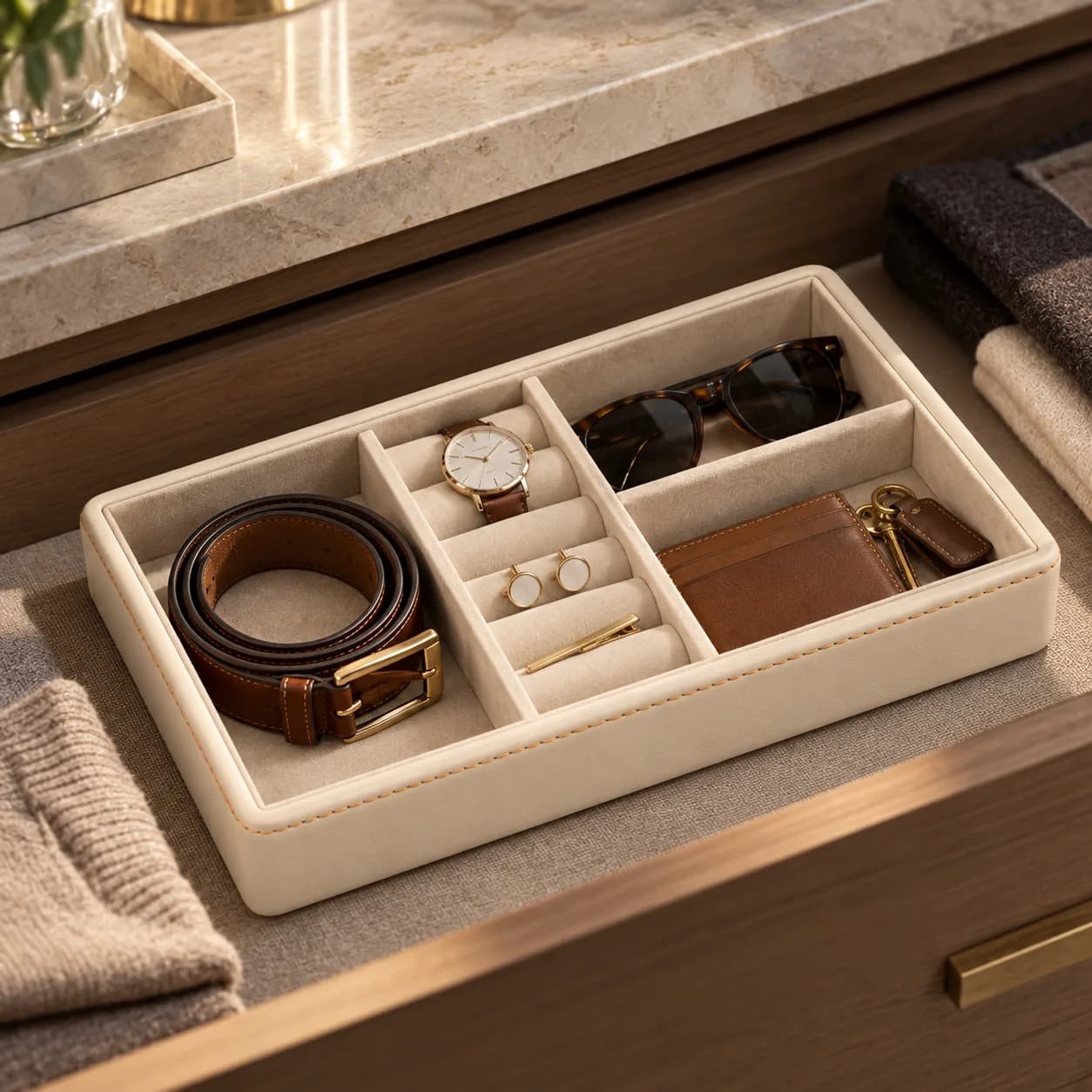
A drawer organiser has to satisfy both: it must fit the drawer and hold the contents. For that, measure the inside of the drawer, width, depth and height, and take 2 to 3 mm off each side so the tray lifts in and out. See an example in our custom-fit drawer organiser.
Board thickness follows size
The longer the tray, the thicker the board needs to be so walls do not bow and the floor does not sag. Our starting rule: longest side up to 400 mm uses 4 mm board, up to 500 mm uses 6 mm, longer than that 9 mm. Trays carrying real weight, such as a room service tray with a teapot and plates, may need more.
On our 3D tray designer you can let it choose the board automatically. It shows the resulting inside size immediately and warns you if you pick a board thinner than recommended.
Tolerances: agree on a common language
Wood and leather move with humidity, so wrapped trays are never as precise as machined metal. Engineering has ISO 2768-1, which sets general tolerances in fine, medium, coarse and very coarse classes. It was written for metal parts, not upholstered work, but it gives both sides a shared vocabulary: for dimensions of 120 to 400 mm, medium allows ±0.5 mm and coarse ±1.2 mm.
What actually works is telling the factory which limit cannot be crossed, for example “outside must not exceed 452 mm, the drawer is 455 mm wide.” That one sentence is clearer than a full tolerance table.
What to send with a quote request
The size you need, stating whether it is outside or inside; the number of compartments and the size of each; material and colour; whether you want a logo; where it will be used, dry or wet; and quantity. If it has to hold something specific, such as bottles, files or cases, send photos with measurements, or better still, send the item for us to measure.
We make to order with no minimum, so you can order a single tray to test first. Send details through our quote request page or contact us, and browse all tray types.
References
International Organization for Standardization. ISO 2768-1:1989 General tolerances, Part 1: Tolerances for linear and angular dimensions without individual tolerance indications.